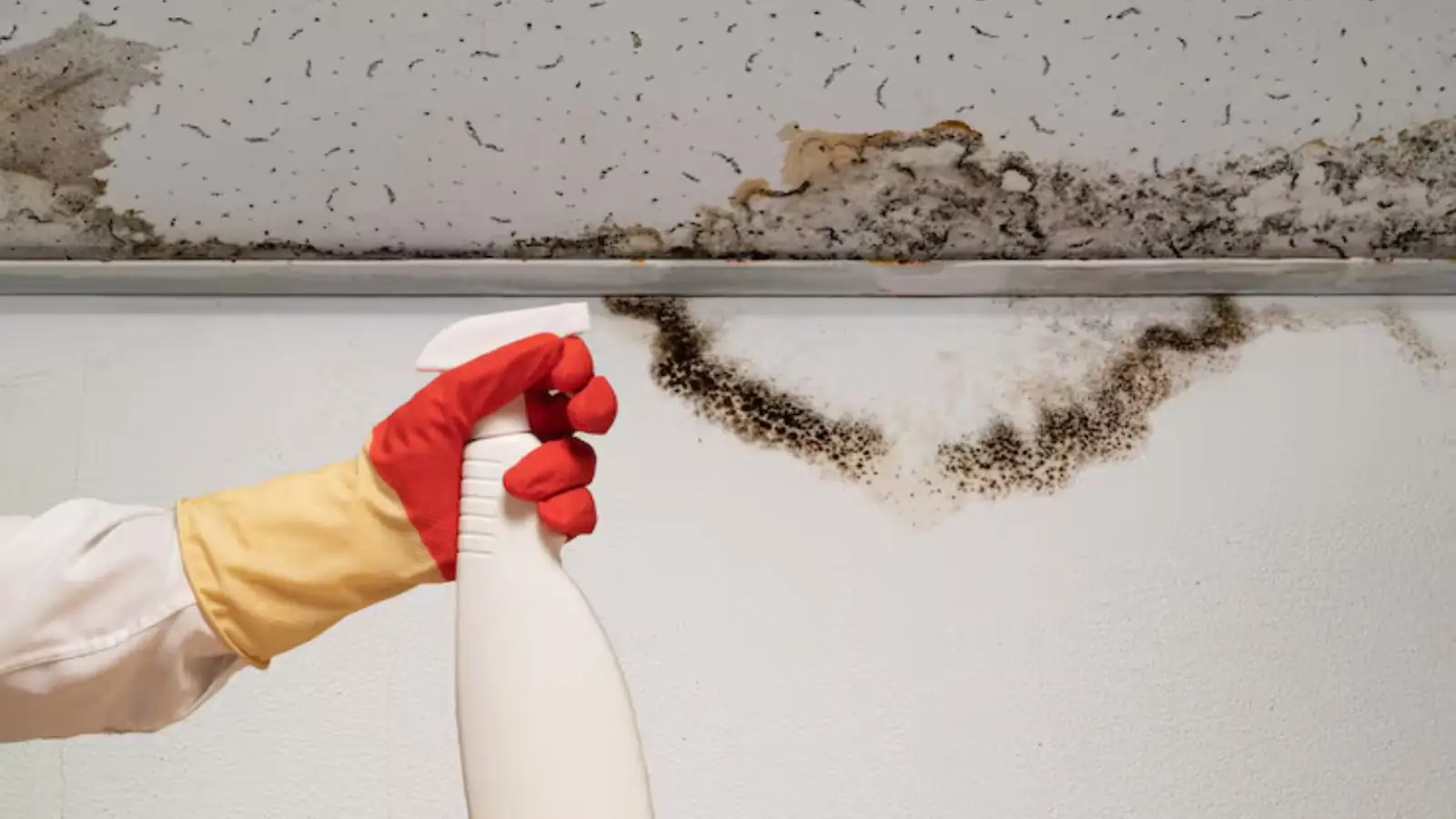
A dark spot on a ceiling is not always mold, and color alone cannot settle the question. Mold tends to look fuzzy, speckled or slightly raised, while a smooth brown ring is more often a dried water stain. Either way, the spot points to moisture, so fix the water first. A patch under about 10 square feet can usually be cleaned with detergent and water. Anything larger is a job for a professional.
What a dark ceiling spot can actually be
Five things cause most dark ceiling marks: mold, mildew, dirt, soot and water stains. Mold and mildew are both fungi, and people often use the word mildew for the flat, powdery kind. Dirt and soot settle on the surface, usually near vents, fixtures, candles or a fireplace. A water stain is made of minerals and residue that water carries out of drywall, wood or insulation, so it can look dark even when nothing is growing.
The CDC says you do not need to know the type of mold in your home. Black, green, gray and white growth all call for the same response. So the useful question is not whether it is the famous black kind. Ask instead whether the area is wet, how large it is, and where the water is coming from.
How to read the pattern before you touch it
Look at the shape first. Pattern gives you better clues than color, and you can read it from the floor with a flashlight held at a low angle.
- Rings with a darker edge and a lighter middle: usually an old water stain, where a leak wet the ceiling, dried, then wet it again.
- Fuzzy or speckled spots that spread over weeks: more likely mold growth, especially near a bath or an exterior wall.
- Dark lines that follow the framing: often called ghosting, and tied to dust and moisture collecting on the cooler spots over joists.
- Dark smudges around a vent or light: often dirt or soot moved by air, though moisture can hide there too.
Next, press lightly with a gloved hand. A ceiling that feels soft, sags or bubbles has held water recently or still does. That is a sign to stop and find the source, not to start scrubbing.
| What you see | What it may be | Next step |
|---|---|---|
| Brown ring with a darker edge, smooth to the touch | Old water stain from a past leak | Check for a current leak, let the area dry fully, then decide on cleanup or repair |
| Fuzzy, speckled or slightly raised spots | Mold or mildew growing on a damp surface | Find the moisture source, then clean small areas or call a pro for larger ones |
| Dark stripes lining up with joists | Ghosting from dust and moisture on cooler framing | Check insulation, attic ventilation and indoor humidity |
| Dark smudges near a vent or fixture | Dirt or soot carried by air | Wipe a small test patch, and watch whether it returns |
| Sagging, bubbling or dripping drywall | Active or recent water intake | Treat as a water problem first and get it checked quickly |
Need help with this today?
Dispatch is open 24 hours a day, every day.
Why bathrooms and rooms below leaks show it first
Bathroom ceilings collect steam every day. If the shower fan is weak, clogged, or vents into the attic instead of outside, warm wet air settles on the ceiling surface and stays there. Kitchens and laundry rooms can do the same on a smaller scale.
Rooms under a roof leak or upstairs plumbing show a different pattern. The water enters above, spreads through insulation, and shows up as a stain that can be several feet from the real leak. A ceiling spot under a second-floor bathroom deserves a look at the tub, the toilet seal and the drain lines. If drywall is wet from a supply or drain leak, early water mitigation work can limit how far it spreads.
What to check first: the moisture source
The EPA says the key to mold control is moisture control. Cleaning a ceiling without stopping the water is like mopping beside a running tap. Work through the likely sources in order.
- Look in the attic or crawl access above the spot for wet insulation, dark wood, daylight at the roof deck or damp ductwork.
- Run the bathroom fan and confirm air actually leaves through a vent cap on the roof or wall, not into the attic.
- Check the roof flashing, vent pipes and gutters after a hard rain.
- Inspect plumbing above the ceiling: supply lines, drain lines, shower pans and appliance connections.
- Watch for condensation on cold surfaces such as uninsulated ducts or window frames.
If you see water near light fixtures, outlets or a wet panel, stay away from it. Cut power only if you can reach the panel while standing dry. Call the utility or 911 for electrical or gas concerns before you call anyone else.
Wipe it down or call a professional
The EPA treats mold under about 10 square feet, roughly a 3 foot by 3 foot patch, as a job many homeowners can handle. Wear gloves, goggles and an N-95 respirator. Scrub with detergent and water, then dry the surface completely. Bleach is not recommended by the EPA as a routine cleanup method, and bleach should never be mixed with ammonia.
Call a professional when the growth is larger than 10 square feet, when a lot of water got into the building, or when the water came from sewage or another contaminated source. Also call if the drywall is soft or the spot returns after cleaning. Professional mold remediation involves containing the area and removing affected materials, and testing and remediation follow the ANSI/IICRC S520 standard. Ask any company whether its crews work to it.
Porous materials such as ceiling tiles may have to be thrown away if they are moldy, since scrubbing cannot reach the inside. Visible mold usually does not need sampling first, and the CDC does not recommend routine mold testing. Questions about how mold affects anyone's health belong with a physician.
What not to do, and what comes after cleanup
Do not paint over a dark spot. Paint hides the mark but leaves the moisture and the growth underneath, and a stain-blocking primer does not fix a leak. Do not dry-brush or sweep dry mold, which spreads it through the room. Do not mix cleaning products.
Once the source is fixed and the area is dry, repair can start. Damaged drywall, insulation and paint are rebuilt after drying, and water damage repair covers that phase. Keep the fan running during and after showers, and keep the humidity in the house moderate, since mold needs moisture to grow.
If you are unsure what you are looking at, call (425) 592-3399 and describe the spot. Scope and price explained before work starts, and we serve homeowners in Mukilteo and nearby towns such as Everett and Edmonds.
Mukilteo local note: wet winters and who to call
Mukilteo has mild, rainy winters and dry summers. After a wet season, a quick look at the attic ceiling, the roof vents and the bath fan duct is a sensible habit, since slow roof and venting problems often show up first as a ceiling mark.
According to the EPA's mold cleanup guidance, drying wet areas within 24 to 48 hours helps prevent mold. If a stain sits near a light fixture, remember that the City of Mukilteo's utilities page lists Snohomish County PUD for electric service and Puget Sound Energy for gas. Call them about electrical or gas concerns, and ask the city's Planning Department how permit rules apply if repairs go beyond cosmetic work.
Frequently asked questions
No. Color does not identify mold, and the CDC says you do not need to know the type. Treat any mold the same way: fix the water, then clean or remove it.
For questions about health, ask a physician.
Painting hides the stain but not the cause. If moisture is still present, the mark can reappear and the material underneath keeps getting worse. Stop the water, dry the area, clean or replace what is affected, and then paint.
The EPA guideline is about 10 square feet, roughly 3 feet by 3 feet. Use gloves, goggles and an N-95 respirator, scrub with detergent and water, and dry it completely.
Above that size, after a lot of water damage, or with sewage involved, call a professional.
Usually not. The EPA says sampling is generally unnecessary when mold is visible, and the CDC does not recommend routine testing. Your effort is better spent finding the moisture source.
A repeat spot often means moisture is still reaching the ceiling. Check that the fan is strong enough, that it vents outside, and that you run it during and after showers. A slow leak from above can also be the cause.
It is common enough to check but not something to ignore. Heavy rain can show a roof flashing, gutter or attic venting problem. Look at the attic first, and if the drywall is soft or damp, call a pro for a moisture check.
Still have a question? Call (425) 592-3399, any hour.